July 1, 2011

Sacramento-San Francisco Train Accident Attorney Comments on BART Incident

Yesterday, a woman lying the tracks at Glen Park Station escaped with minor injuries after a train traveling at 30mph passed over her, according sfexaminer.com. Bart police shut down the station during the morning commute to determine how the woman managed to get on the tracks. The spokesman for Bart said that a train operator tried to slow down when he saw the woman standing up on the Glen Park tracks at around 8:15 a.m. The woman managed to lie flat on her back as the train traveled over her. Seven train cars passed over before she was able to climb up out of the tracks. When BART police found her she was covered in soot and distraught, but without major injuries. The woman was not a disabled or blind passenger. She went to the hospital for evaluation of her injuries. As a result of the incident, passengers traveling in all directions experienced major delays yesterday.

It is astonishing that the woman walked away without any major injuries. There has been several train accidents involving pedestrians in the Bay Area this year, and those victims were not as lucky. Common injuries from train accidents include brain injury, spinal cord injury, broken bones and fractures, internal organ damage, and death. Train accidents involving pedestrians usually occur because people, for whatever reason, either purposefully or by accident, wander onto train property and rights-of-way.

If you or someone you know sustained an injury related to a BART accident, or any other form of public transportation, please contact our firm for a free consultation. After sustaining a personal injury in accident involving BART or other public transportation, you want to make sure to hire an experienced personal injury attorney, as different municipal transportation case has different insurance procedures. Here at the Brod Law Firm we will be there to guide you through the process, make sure your rights are protected, and make it easy help you get the compensation you deserve.


June 26, 2011

San Francisco-Oakland Injury Lawyer comments on Amtrak Train Crash in Nevada

On Friday, June 24, an Amtrak train bound for Emeryville from Chicago, crashed in Nevada, killing at least 6 people. It has been reported that a truck crashed into the side of the train, though a team of 18 investigators from the National Transportation Safety Board ("NTSB") has not yet been able to determine how and why the crash occurred. The driver of the truck unfortunately died in the crash, however, leaving certain key questions unanswered.

In California, a party may bring a lawsuit in a variety of venues. Under California law, a party may file a lawsuit in the County where an injury, or the injury causing death occurs, or in the County where the defendants, or some of them reside, at the time the lawsuit is filed. Though this terrible train crash took place in Nevada, an injured person or the loved one of a person whose life was lost in this tragedy, may be able to pursue their claim in the State of California. Speaking with an experienced attorney is the best way to understand your rights. If you, or a loved one has been injured in this terrible Amtrak crash, or in any other train crash, please contact the Brod Law Firm for a free consultation.

April 8, 2011

Caltrain Strikes and Kills a Man

Yesterday, a southbound Caltrain struck and killed a man in San Mateo Thursday morning, according to the San Francisco Examiner. Train No. 198 left San Francisco station at 12:01 a.m. and hit the pedestrian on the tracks about 100 yards north of 25th Avenue at around 1am. Authorities are investigating how the man ended up on the tracks. There were 62 passengers on the train at the time of the incident, which continued southbound shortly after 2 a.m. and made all scheduled stops.

When a train accident occurs and you are injured or a family member is injured or killed, you may think that seeking monetary damages is an inadequate form of compensation, but monetary compensation can help pay for the medical bills and living needs of the train accident victim’s family. Victims injured by a train need to prove, with the aid of an attorney, that the defendants failed to act in a carful manner when they had a duty to do so and that the accident caused their injuries. Since each train crash is different, and each victim’s injuries and losses are unique, the types of damages available in each train crash will be different. An attorney can help you decide which kind of damages you should seek, such as medical bills and health care costs, future health care costs, property damage, impaired earning capacity, lost wages, pain and suffering, life care, and wrongful death. And because each train accident is unique, as they can have a single cause or multiple causes, a qualified and experienced attorney can decipher, with the help of accident reconstructionists, engineers and other experts, all the parties that can be held liable for a victim’s injuries.

Here at the Brod Law Firm, we have litigated and settled a large number of personal injury claims on our clients’ behalf, and we are able put our legal expertise to work on any personal injury case, including train accidnets. If you or a family member suffered an injury due to the negligence of another, please contact our firm. Our firm will work hard on your claim to get you the compensation you deserve for your injuries, and we will fight on your behalf in court when a settlement is not possible

February 1, 2011

Oakland-San Francisco Accident Attorney Comments on Train Accidnets

Last Saturday a train hit a truck in Watsonville at Kirby and Elkhorn road just after 1pm. The engineer did try to apply the emergency system to bring the train to a stop, but there was not enough time to do so. The train ended up hitting the truck at approximately 50 miles per hour. Both people in the pick-up died at the scene. Nobody on the train was hurt. The specific cause of the collision is still under investigation, but CHP said the driver wasn’t speeding and doesn’t believe she was under the influence.

According to the Federal Railroad Administration Office of Safety Analysis (FRAOSA), Highway-rail and trespassing incidents account for 95.46% of all fatalities, and highway-rail incidents represent 17.73% of all reported events. As defined by the FRAOSA, a highway-rail incident is any impact between a rail and a highway user at a crossing site, regardless of severity and includes motor vehicles and other highway/roadway/sidewalk users at both public and private crossings. In 2010, there were 1817 incidents, 245 fatalities and 751 nonfatal incidents at crossings, and 428 fatalities and 351 incidents at non-crossings.

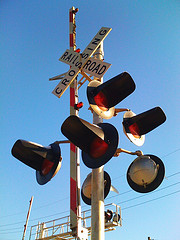
Here at the Brod Law Firm, we are usually surprised by reports of train-crossing accidents, as it is hard to comprehend how a train could sneak up on someone. However train accidents, such as the one that happened over the weekend, and the above statistics prove that they happen more than one would think, which underlies the need for learning life-saving practices to help avoid a collision with a train. The following are a few safety tips to keep in mind the next time you approach a railroad crossing:
• Never drive around a crossing gate that is down
• If you drive into the crossing and the gate behind you comes down, keep driving, even if that means you have to break the crossing gate in front of you.
• Remember that any time is train time.
• Always listen and look both ways twice at a crossing.
• It is your responsibility to avoid a train since it can not avoid you
• Don’t be fooled by train distance--a train is always moving faster and is much closer than you think.
If you or someone you love suffered injuries due to a collision with train, contact our firm. We have over ten years experience helping victims of train accidents receive the compensation they deserve.

November 8, 2010

San Francisco-Oakland Injury Attorney Comments of Train Accidents

Last week, according to SFGate, an Amtrak train struck and killed a man who was walking with a friend on railroad tracks in Albany. The accident interrupted train traffic between San Francisco Bay Area and Sacramento. Investigators interviewed the dead man’s friend to determine what happened. Amtrak said that none of the passengers aboard the train were injured and that they were transferred to another train and taken to the Emeryville station. The Union Pacific spokesman Aaron Hunt said the men trespassed onto the railroad’s tracks.
According to the Federal Railroad Administration Office of Safety Analysis, between January and December of 2009, there were 153 injuries reported on train tracks, 85 of which were fatal and 28 of which occurred between Amtrak and trespassers on the tracks. According to the U.S. Department of Transportation, trespassers now account for the highest number of fatalities in the railroad industry. They state that in many industrialized countries, suicides account for a large number of trespasser fatalities, and the proximity of mental health facilities to rail infrastructure accounts for many “hot spots” in trespasser incidents. They also state that there are many reasons for trespassing on railroad rights-of-way, some of which involve recreation and some that have to do with the romantic notion (planted in our minds by Hollywood) that such acts of trespassing on are some sort of type of cultural right of passage. Trespassing on railroad property is usually a misdemeanor, with penalties ranging from $100 to $1000 or jail, depending on the state. Reviews written by experts recommend, where applicable, increased enforcement and observations by local law enforcement agencies at crossings, especially near schools before and after hours, pedestrian clearance line be placed on either side of the tracks, and “No Trespassing” signs be place on railroad rights-of-way.

If you or a loved one fell victim to train accident, please contact the Brod Law Firm as soon as possible for a free consultation. Our train accident attorney can help you sort through any questions you may have, explain the legal framework surrounding train victims’ rights, and, if you end up filing a claim, help you get the compensation to which you are entitled.

September 17, 2008

L.A. Metrolink Train Crash – Was the driver text-messaging?

On Friday, September 12, 2008, Los Angeles experienced one of the worst U.S. commuter disasters in recent memory. At least 25 people were killed as a result of the Metrolink train crash in the San Fernando Valley that left well over 130 people injured. Reports indicate the train was traveling approximately 42 miles per hour when it ran head-on into a Union Pacific freight train. It has also been reported that the engineer responsible for driving the Metrolink train may have been sending a text-message on his cell phone immediately before the collision.

I have written about the new cell phone laws in the State of California, as well as specific incidents involving bus drivers and possible cell phone usage. According to the N.T.S.B. (National Transportation Safety Board), the Metrolink train failed to stop at a red signal, which appears to have been working, and should have been visible, and the N.T.S.B. has been working to re-enact the crash to learn as much as possible about what happened. Currently, though drivers are prohibited from using hands free cellular devices while driving, the California Public Utilities Commission does not prohibit the driver of a passenger train from using a cell phone or text-messaging, though they are responsible for hundreds of lives. Aside from driver neglect, it is incomprehensible and reprehensible that Metrolink did not have additional safety measure in place to prevent such a catastrophe. In the coming weeks and months after this catastrophe, we can expect to see new legislation introduced as a direct result of this horrible event.